RV camping without hookups for six days sounded peaceful… until things started breaking.
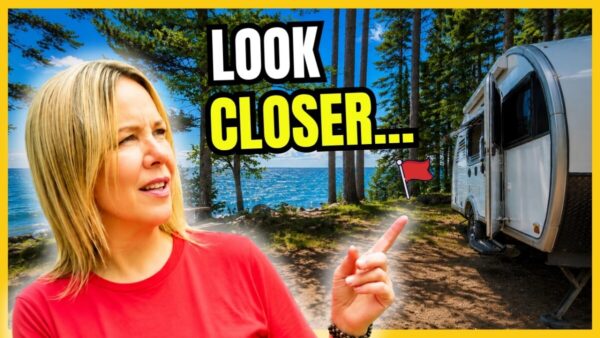
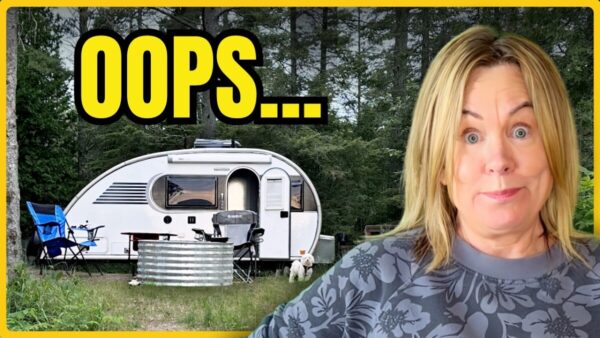
I had driven more than 300 miles to Michigan’s Upper Peninsula for what I thought would be a relaxing solo RV camping trip on Lake Superior with my dog, Thor. I was staying at a beautiful Hipcamp campsite with my camper, surrounded by trees, with my own boardwalk leading down to the water.
No electric hookup. No water hookup. No sewer hookup.
Just me, Thor, my camper, and six nights of quiet camping on Lake Superior.
At least, that was the plan.
Before long, my cooking setup failed, something inside my camper literally fell apart, and then my screen door decided it had had enough too.
But here’s the thing: even with the problems, this trip reminded me why I love camping without hookups so much. Staying somewhere quiet and peaceful, away from crowded campgrounds, is worth a little extra planning — and apparently, a sense of humor.
In this post, I’m sharing what it was really like RV camping without hookups for six nights, how I managed water, tanks, power and internet, what went wrong, and what I would want other RVers to know before trying an off-grid camping trip of their own.
What Does RV Camping Without Hookups Mean?
RV camping without hookups means staying at a campsite without being connected to campground utilities.
That typically means you do not have:
- Electrical hookups
- Fresh water hookups
- Sewer hookups
You may also hear this called dry camping, off-grid RV camping, or sometimes RV boondocking.
The biggest difference is that when you camp without hookups, everything becomes limited. You only have the fresh water you bring with you. Your holding tanks can only hold so much. And your power supply has to last for the length of your stay unless you have a way to recharge it.
For one night, this is usually not a big deal.
For six nights? You have to think things through a little more carefully.
In my case, I was staying at a reserved Hipcamp campsite rather than camping on public land. I still had no hookups at my actual campsite, so I had to plan for the same basic challenges: water, tanks, power, internet and what to do when something unexpectedly goes wrong.
Why I Chose Solo RV Camping Without Hookups on Lake Superior
I love finding camping spots that feel peaceful, quiet and away from the crowds.
This particular campsite was in Michigan’s Upper Peninsula on Lake Superior, and it was exactly the kind of place that makes me excited to pull my camper somewhere new.
The campsite had plenty of room, a picnic table, a nice fire pit and even a porta potty nearby. Best of all, there was a boardwalk from my campsite down to the shoreline of Lake Superior.
It was gorgeous.
This was a Hipcamp location, which is one of my favorite ways to find unique camping experiences. Think of Hipcamp a little like Airbnb for camping: landowners offer places where campers can stay on their property, and the types of campsites you can find are incredible.
Over the years, I’ve camped at a quarry, stayed at a pizza farm, camped beside a flowing river and now camped on Lake Superior.
One thing I especially appreciate about Hipcamp when I am camping alone in my RV is that I can usually communicate directly with the host. At this site, pulling into my campsite made me a little nervous because I am not always confident maneuvering my camper in tight spaces.
Almost immediately, I started wondering: How am I going to get back out of here?
I contacted the host and explained that I was worried about navigating my way out when it was time to leave. He responded right away and arranged for someone to help guide me out.
As a solo camper, that kind of communication can make a big difference.
How I Prepared for 6 Days of Camping Without Hookups
When you are planning to spend nearly a week camping without hookups, the beautiful view is only part of the equation.
You also have to think through a few practical questions:
- How much fresh water will I have?
- How quickly will my black tank fill?
- Will I have enough battery power?
- How will I cook?
- What will I do if I have poor cell service?
- What backup options do I have if something breaks?
I had prepared for most of these things.
What I did not prepare for was several parts of my camper deciding to break on the same trip.
But we’ll get to that.
Managing Fresh Water While RV Camping Without Hookups
One of the first things to think about when planning RV camping without water hookups is where your fresh water will come from.
Because there was no water connection at my campsite, I stopped at a nearby campground before arriving and filled my camper’s fresh water tank.
That gave me water inside the camper for normal use during my stay.
When you are dry camping in an RV, it helps to be mindful of how much water you use. Things like long showers, washing dishes under running water or using water without thinking about it can drain your fresh water tank much faster than expected.
For me, the goal is not to make camping feel inconvenient. It is simply to pay a little more attention so my water lasts as long as I need it to.
If you are planning your first extended trip without hookups, I would find out ahead of time:
- How many gallons your fresh water tank holds
- Whether there is a nearby place to fill it before arriving
- Whether potable water is available anywhere near your campsite
- How much water you typically use in a day
A quiet remote campsite is wonderful — right up until you run out of water much sooner than expected.
The Black Tank Problem Nobody Loves Talking About
Let’s talk about the not-so-glamorous part of camping without hookups: your black tank.
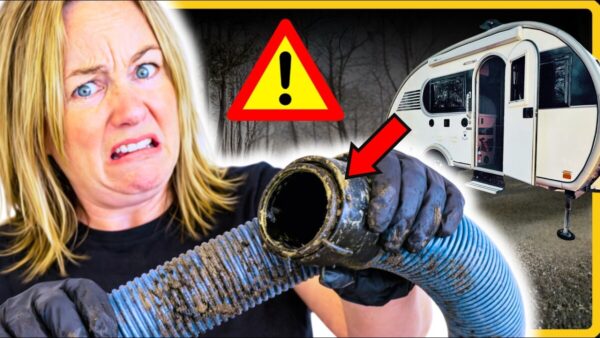
My camper has a small 9-gallon black tank. When I am camping for six nights, especially without a sewer hookup, that is something I absolutely have to think about.
For this stay, I knew I would be pushing it if I relied only on my camper bathroom the entire time.
That is why having a porta potty at this campsite was such a big deal. It allowed me to extend how long I could stay without needing to worry about my black tank filling before the trip was over.
My gray tank is rarely my biggest concern. In my camper, the black tank tends to fill much sooner than the gray tank becomes a problem.
Every RV setup is different, so before planning an extended off-grid RV camping trip, it is worth knowing the capacity of all three of your tanks:
- Fresh water tank
- Gray water tank
- Black water tank
If you have a small camper like mine, your black tank capacity may determine how long you can comfortably camp without hookups unless there is another bathroom option nearby.
That is one detail I now pay very close attention to when booking a campsite.
Powering My Camper Without Electrical Hookups
When people first think about camping without hookups, power is usually one of the biggest concerns.
How will you keep your camper battery charged? Can you use your appliances? What happens if you need air conditioning?
We had lithium batteries and solar installed in our camper, and for this trip, that ended up being incredibly helpful.
Because I had lithium batteries, I was able to use my microwave even though I had no electric hookup. I did not realize just how important that would become until my cooking plans completely fell apart.
Do you need lithium batteries in order to camp without hookups?
No.
You can absolutely dry camp without lithium batteries, especially for shorter stays or if your power needs are minimal. But the longer you plan to stay without electrical hookups, the more helpful a good battery and solar setup becomes.
Here is how I managed power on this trip:
- Lithium batteries and solar helped power my camper and allowed me to use the microwave.
- My Jackery portable power station kept my devices charged without draining my camper battery as quickly.
- My DeWalt fan helped keep me comfortable since I cannot run my air conditioner all night from my battery system.
I could not simply use every appliance the way I would at a full-hookup campsite. Air conditioning overnight was not realistic for my setup.
But with the right expectations and a few helpful upgrades, I had more than enough power for the things that really mattered.
Check Out HipCamp and Save $10 Here:
https://geni.us/8732×7
Staying Connected While Off-Grid RV Camping
Another challenge with remote camping locations is cell service.
At this Lake Superior campsite, my cell signal was very poor. That is not unusual when I camp in quieter, more remote places.
For a lot of campers, having limited service may be part of the appeal. But because I create YouTube videos and work while I travel, I still need a reliable way to get online.
My Starlink Mini has been a game-changer for trips like this. It allowed me to work on and upload my video even when my regular cell service was not dependable.
Internet may not be essential for every RV camper, but when I am solo camping, it also gives me extra peace of mind knowing I have another way to stay connected in an area with poor cell service.
When you are planning an off-grid camping stay, especially by yourself, it is worth checking ahead of time whether you will have cell coverage and deciding whether being completely disconnected works for your situation.
Then My Camping Trip Started Falling Apart
Now let’s get to the part I definitely did not plan for.
I had brought sticky buns with me, and I had been thinking about cooking them all week. My plan was to use my outdoor grill, enjoy a delicious breakfast and settle into my peaceful Lake Superior camping trip.
But when I opened up my grill, I saw something I was absolutely not expecting.
Mold.
A lot of it.
Immediately, I started wondering what I was supposed to do. Could I clean it? Would I even feel comfortable cooking on it after cleaning it? What about the hamburger and chicken I had brought along for meals?
I am not the greatest cook, so grilling meat or fish at the campsite is usually my go-to plan. It is simple, it works and it usually turns out pretty well.
Except now I had no grill.
Unfortunately, it got worse.
The day before, I had gone to open a drawer inside my camper and noticed it was jammed. When I looked closer, I realized the bottom of my gas stove had literally fallen apart.
So now I did not have an outdoor grill.
And I did not have an indoor stove.
On a six-night solo camping trip without hookups.
You cannot make this stuff up.
When Your RV Cooking Setup Fails While Dry Camping
Losing both my stove and my grill at the beginning of the trip was frustrating, but fortunately, it was not a trip-ending emergency.
Because my camper has lithium batteries, I could still use my microwave. That meant I needed to change my meal plan and find microwaveable food options instead of cooking the meals I had originally packed.
Was that the camping food experience I had pictured for this beautiful waterfront trip?
Not exactly.
But it was manageable.
This experience reminded me that when you are RV camping without hookups — especially in a remote location — it is helpful to have at least one backup food option.
That might mean packing a few meals that do not require cooking, keeping easy microwaveable options on hand if your setup allows it, or simply knowing where the nearest grocery store is.
In my case, the microwave saved my meals for the rest of the trip.
Thank goodness for those lithium batteries.
And Then My Screen Door Broke Too
At this point, I thought I had reached my limit of unexpected camper problems.
Apparently, my camper disagreed.
I was sitting inside working on my video when Thor wanted to go outside. I went to open the screen door, and it completely came apart.
The screen door was already not in great shape and needed to be replaced, but I certainly did not expect it to detach from the door frame while I was trying to let my dog outside.
There I was, solo camping without hookups, after my grill problem, my stove problem, and now my screen door was hanging there broken too.
At a certain point, all you can do is laugh.
My husband and I have owned this camper for eight years, and we have taken it a lot of places. As campers get older and get used more often, things do eventually need repairs and replacement.
Still, I was not particularly excited to tell my husband I had yet another item to add to his to-do list when I got home.
What Worked Well on My RV Camping Without Hookups Trip
Even with all of those frustrating camper problems, many parts of my setup worked exactly the way I needed them to.
My Water Plan Worked
Filling my fresh water tank before arriving meant I had the water I needed at the campsite, even without a hookup.
The Porta Potty Made a Huge Difference
With only a 9-gallon black tank, having another bathroom option available helped make a six-night stay much more realistic.
My Lithium Batteries and Solar Saved the Trip
Being able to use my microwave became far more important once my stove and grill were no longer usable.
My Portable Power Options Helped Extend My Stay
Using my Jackery for device charging and my DeWalt fan for comfort helped me avoid unnecessarily draining my RV battery system.
Starlink Mini Kept Me Connected
Poor cell service did not keep me from working, uploading my video or having another connection option during a solo camping trip.
Communication With My Hipcamp Host Helped Me Feel More Comfortable
When I was nervous about maneuvering my camper out of the site, being able to contact the host and get help arranged made leaving much less stressful.
What I Would Do Differently Before My Next No-Hookups Camping Trip
I would absolutely go solo RV camping without hookups again. In fact, the peaceful shoreline, the quiet campsite and the entire Lake Superior experience are exactly why I love this kind of camping.
But this trip did remind me of a few things I should check more carefully before heading out on another extended stay.
Check My Cooking Equipment Before Leaving Home
I definitely wish I had opened my grill and inspected it before driving more than 300 miles away from home.
Make Sure I Have a Backup Meal Plan
Even with a working grill and stove, it is smart to have a few simple meal options available in case cooking outside is not practical or equipment fails.
Inspect Older Camper Components More Closely
After eight years of use, my camper is reaching the point where some things are naturally starting to wear out. Checking doors, stove components and commonly used parts before a longer trip can help avoid surprises.
Continue Paying Attention to Tank Capacity
My 9-gallon black tank is a big limitation on longer stays without sewer hookups. Knowing whether a campsite has a bathroom option nearby is important for how I plan future trips.
Is Camping Without Hookups Worth It?
For me, absolutely.
There is something special about pulling my camper into a quiet campsite where I can hear the waves, walk down to the shore with Thor and enjoy a beautiful place without being surrounded by rows of other RVs.
Yes, camping without hookups takes more planning.
You have to manage your water. You have to understand your holding tanks. You have to pay attention to your power use. And sometimes, you have to improvise when your camper decides to give you a few unexpected surprises.
But even after losing my grill, my stove and my screen door on the same camping trip, I still would not trade the experience.
Because when I think about this trip, I do not only think about the things that broke.
I think about Lake Superior.
I think about sitting by the water with Thor.
I think about waking up somewhere beautiful, quiet and peaceful.
That is why I camp.
Frequently Asked Questions About RV Camping Without Hookups
Can You Camp in an RV Without Hookups?
Yes. You can camp in an RV without electric, water or sewer hookups as long as you plan for your fresh water supply, tank capacity and power needs. This is often called dry camping or off-grid RV camping.
What Is Dry Camping in an RV?
Dry camping in an RV means camping without connecting your camper to campground water, sewer or electrical hookups. You use the water in your fresh tank, rely on your RV batteries or portable power, and monitor your gray and black tanks during your stay.
How Long Can You RV Camp Without Hookups?
How long you can RV camp without hookups depends on your camper setup, your fresh water capacity, your gray and black tank sizes, your battery power and how carefully you use each resource. For me, my 9-gallon black tank was the biggest limiting factor for a six-night stay.
Do You Need Lithium Batteries for RV Camping Without Hookups?
No, lithium batteries are not required for camping without hookups. However, they can be very useful for longer stays, especially if you want more power flexibility. On my trip, lithium batteries allowed me to use my microwave after both my stove and outdoor grill became unusable.
How Do You Handle a Black Tank When Camping Without Sewer Hookups?
Before an extended trip, know the size of your RV black tank and consider how quickly it normally fills. My camper has a 9-gallon black tank, so having access to a porta-potty at the campsite made staying six nights without sewer hookups much easier.
How Do You Get Internet While Off-Grid RV Camping?
Cell service can be unreliable in remote camping locations. At my Lake Superior campsite, my signal was poor, so I used my Starlink Mini to stay connected and upload my video.
Is Solo RV Camping Without Hookups Safe?
Solo RV camping can be a wonderful experience, but I always pay attention to the location, communication options and my comfort level. At this Hipcamp campsite, being able to contact the host directly and knowing help was available when I needed assistance navigating out of the site helped me feel more comfortable during my stay.
My Final Thoughts on Solo RV Camping Without Hookups
This trip may not have gone according to plan, but it was definitely memorable.
I headed to Michigan’s Upper Peninsula expecting six peaceful nights of RV camping without hookups on Lake Superior with Thor.
Instead, my grill became unusable, my stove fell apart, my screen door broke, and my meal plan turned into microwave food.
And yet, I still loved this trip.
Sometimes camping is not perfect. Sometimes your equipment fails, your plans change, and you end up laughing at how many things can happen in a matter of days.
But those unexpected moments are part of the adventure.
Would I camp without hookups again?
Absolutely.
I may just check my grill, stove and screen door before I leave next time.
Helpful RV Camping Resources
Find Unique Campsites on Hipcamp
I have found some incredible camping experiences through Hipcamp, from riverside sites to Lake Superior views. When I am solo camping, I especially appreciate being able to read reviews and communicate directly with the host.
Click here to try HipCamp for yourself! https://geni.us/8732×7