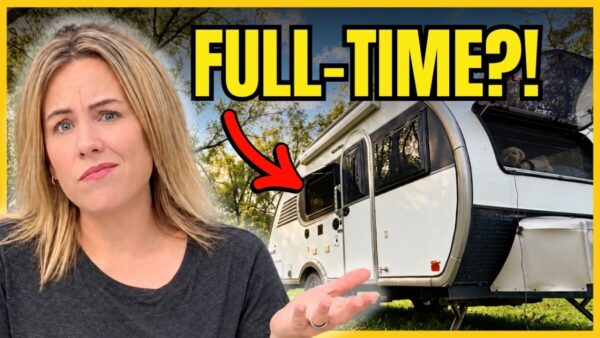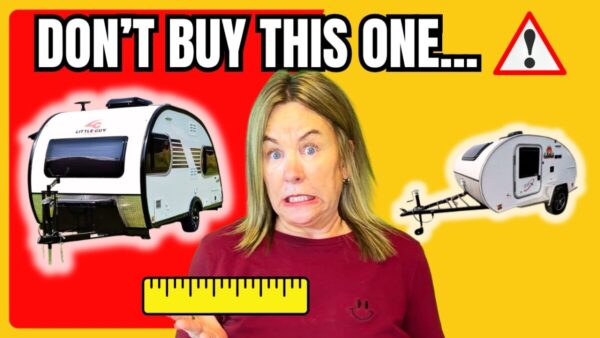
That small travel trailer looks wonderful on an RV tour—but what will you discover after your first night inside? Before you fall in love with the layout, consider the everyday details that can turn a beautiful camper into a frustrating fit.
After eight years camping in my Little Guy Max and touring hundreds of campers, I’ve learned to look beyond the pretty version. I love small travel trailers, especially the freedom to camp in places where bigger rigs might not fit. But choosing one means deciding which compromises work for you.
These are 10 RV buying mistakes to avoid, based on what I notice during tours and what I’ve experienced using my own trailer.
Disclosure: Happy Campers sponsored part of the accompanying video and is providing the giveaway prizes. Some product links, when added, may be affiliate links. I may earn a commission on purchases through those links at no additional cost to you.
1. Choosing a Dry Bath Without Considering the Living Space
“Ooh, a separate shower!” I understand the appeal. My Little Guy Max has a wet bath, which means the shower and toilet share a space. When I shower, the toilet gets rinsed, too—whether it needs it or not.
But before you declare a wet bath a dealbreaker, turn around and look at the rest of the camper. A roomier bathroom can mean less seating, less storage, or a tighter walkway.
Personally, I’d rather use that space elsewhere. I spend more time hanging out in my trailer than washing my hair! You might happily choose the shower. Just picture a rainy afternoon inside before deciding.
On your next tour: Compare the whole floor plan, rather than letting one appealing feature make the decision for you.
2. Overlooking Freshwater, Gray, and Black Tank Sizes
Tank capacities affect how you camp, especially without hookups. Your freshwater tank holds your water supply, the gray tank collects used sink and shower water, and the black tank holds toilet waste.
All three matter. In my experience, the black tank is usually the limit I reach first.
My Little Guy Max has a nine-gallon black tank. Solo, I usually get six or seven days. When my hubby Tom joins me, it’s about three or four. Apparently, togetherness has a tank limit.
Those are my results, not a promise for every camper. Your habits and setup will affect how long your tanks last.
Without a sewer hookup, emptying a tank can mean packing up, hitching up, driving to a dump station, and returning to set up again. That’s worth considering before planning a week in one beautiful spot.
On your next tour: Ask for all three capacities and consider whether they fit your preferred length of stay.
3. Forgetting That the Bathroom Is Always Close By
Here’s something a video tour can’t convey: smells.
In a small travel trailer, your kitchen, bed, and lunch are never very far from the toilet. That’s not the kind of open-concept living most people picture!
I’ve used Happy Campers holding-tank treatment for years to help control holding-tank odors. It won’t make my nine-gallon tank any bigger, but some things are better left unnoticed.
Happy Campers Giveaway
Happy Campers is providing holding-tank treatment for three winners. Enter through the giveaway page by December 10, 2026, at 11:59 p.m. Central Time. Entry is free; see the Official Rules for eligibility, prizes, and notification details. YouTube is not a sponsor of the giveaway.
https://randisadventures.com/win-happy-campers-tank-treatment/
Prefer to shop? Find the holding-tank treatment I use here: https://geni.us/FjhVGb
4. Assuming the Bed Will Feel Like Your Bed at Home
A bed that looks inviting during a walkthrough may feel very different when you stretch out on it. Check the actual mattress dimensions instead of relying on the word “queen.”
If two people will sleep there, both should try it together. Lie in your usual position, sit up, and roll over. Then picture getting up at two in the morning. Can you leave from your own side, or will you be climbing over someone?
A walk-around bed would feel like a luxury after years of crawling over Tom. But those side aisles also occupy space that another layout might use differently.
Mattress comfort matters, too. Many beds I’ve tried on tours felt thin or firm to me; your preferences may differ. In my trailer, adding a Froli sleep system beneath the mattress made a big difference. Later, I replaced the mattress, and that combination worked wonderfully for me.
My bed upgrades:
Froli Sleep System: Save 15% with code RANDI: https://geni.us/ugxEb
RV Mattress: https://geni.us/mALEuA
5. Testing the Seating Alone Instead of Imagining Everyone Inside
That cute dinette looks perfect for meals and cards. Now picture sitting there for three hours while it rains.
Can everyone relax? Where do feet go? Can someone get up without asking another person to move? Where will the dog settle?
Add a camping partner, Thor underfoot, and a bathroom close to the bed, and a roomy-looking interior can feel very different. Privacy matters as much as seating: getting dressed, using the bathroom, or wanting a few quiet minutes all happen in the same compact footprint.
On your next tour: Sit down together and try moving around each other. “We’ll just sit by the campfire” works beautifully—until the campfire is underwater.
6. Mistaking Covered Appliances for Usable Kitchen Counter Space
“Look at all that counter space!”
Now lift the sink cover and open the stove. Where did your kitchen go?
Picture preparing an actual meal with a cutting board, ingredients, and somewhere safe for a hot pan. Check whether there’s an outlet where you’d use a countertop appliance.
Open the refrigerator, too. Imagine groceries for everyone, leftovers, and drinks inside—not just empty shelves. Is there enough freezer space for the way you shop and travel?
I grill outside often, so a simple kitchen works for me. If you love cooking, mentally prepare a favorite meal during the tour. You’ll learn more than you will admiring the backsplash.
7. Counting Cabinets Instead of Checking Practical Storage
Empty cabinets look enormous. Add clothes, dishes, snacks, dog supplies, and cleaning gear, and the picture changes.
Open drawers and cupboards. Can you reach the back? Will your belongings fit through the opening? My Little Guy Max has useful storage, but adding drawers to my closet helped me make better use of it. Having a big cabinet is one thing. Finding your underwear is another.
Outside, think about chairs, hoses, leveling equipment, tools, and your table. A roomy pass-through compartment is high on my wish list because it can accommodate longer items and offer access from either side.
Check the compartment doors as carefully as the space inside. Your favorite chair has to fit through the opening!
On your next tour: Mentally pack your usual gear, including the items you need first when setting up. Anything that ends up in your truck also takes up space and adds weight there.
8. Assuming Everything Works When You Unplug
The lights are on, the refrigerator is cold, and outlets are everywhere. But a camper on display may be plugged into outside power.
Ask what works without hookups. A standard household-style outlet may need shore power or an inverter; having an inverter doesn’t automatically mean every outlet or appliance is supported.
I love boondocking: more scenery, fewer neighbors, and places bigger rigs can’t squeeze into. That makes battery capacity and charging especially important to me.
Think of the battery as stored energy. More capacity gives you more to use, but it isn’t unlimited. Solar can replenish some of that energy, with results depending on the system and conditions.
On your next tour: Describe your actual plans. For example: “I want to run the lights, fan, and refrigerator for three days without hookups.” Ask what the included system can support and what upgrades would cost. Running air conditioning off-grid deserves its own detailed discussion.
9. Judging RV Quality by Attractive Finishes
Beautiful cabinets deserve a closer look. Open them. Do drawers move smoothly? Do doors latch? Does the table feel sturdy—or does your coffee need a seat belt?
Fit, finish, and how components operate can reveal things worth asking about. They can’t guarantee long-term reliability, and a solid-feeling interior alone doesn’t establish construction quality.
I’m interested in how a trailer is built, including its framing materials. But aluminum framing doesn’t make an entire camper immune to leaks, corrosion, or damage to other materials. Ask about the complete construction and maintenance requirements.
Then talk to owners who’ve used that model for a while. Ask what needed repairs, how long service took, and how the manufacturer or dealer handled it.
On your next tour: Try the things you’ll use every day, then research ownership experiences beyond the showroom.
10. Checking Towing Capacity Without Checking Payload
“Lightweight and easy to tow” sounds reassuring. But you need the numbers for your specific vehicle and loaded camper.
Dry weight isn’t what your trailer will weigh after you add your camping load. Towing capacity is only one limit. Payload is the weight your vehicle can carry, including occupants, gear, hitch equipment, and the trailer’s downward load on the hitch.
Saying “I have an F-150” doesn’t settle the question. Different years and configurations have different ratings. Door-jamb labels provide important information, but you’ll also need the applicable towing guide, equipment ratings, and loaded weights to assess the complete setup.
This confused me during my own camper search. I wanted to go camping, and suddenly I had homework! But a bigger trailer won’t feel like an upgrade if every travel day leaves you gripping the steering wheel.
Before buying: Have a qualified person help verify towing, payload, axle, combined-weight, and hitch limits for your setup, and confirm loaded weights on a scale. Staying within one rating doesn’t mean you meet them all.
Choose a Small Travel Trailer That Fits Your Real Camping Life
The best trailer for you depends on how you use it. A separate shower might be worth less seating. A compact kitchen might suit someone who grills outside. Smaller tanks might work well for short stays or campsites with hookups.
The RV buying mistake is overlooking those choices until after the purchase.
On your next tour, picture a complete camping day: waking up, getting dressed, making breakfast, sitting out a storm, and putting everything away. That’s how you move from admiring a camper to deciding whether it fits your life.
For more practical small-trailer experiences, watch the full video and follow my preparations for full-time RV living.