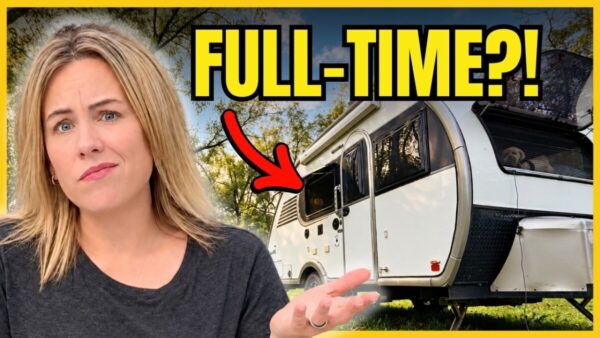
We’re selling our home to retire in our little camper. But before we trade our house keys for campsites, I need to answer a pretty important question: Can we afford to live full-time in an RV?
The last thing I want is to sell everything, hit the road, and discover that our retirement income can’t cover the life we sold everything for.
So I added up our full-time RV living monthly budget for two people and a dog. My current estimate is $4,250 a month, or $51,000 a year. That’s with a paid-off camper and plans to boondock about half the time.
Yes, that number got my attention!
These are our real expenses where I have them and my best estimates where I don’t. We’re still preparing for full-time RV life, so this is our starting budget. A few numbers need more homework before I’ll feel comfortable calling it complete.
Our Full-Time RV Living Monthly Budget at a Glance
Here’s how our planned monthly expenses break down.
| Expense | Monthly budget |
|---|---|
| RV payment | $0 |
| Campgrounds | $700 |
| Fuel | $360 |
| Truck and camper insurance | $282 |
| Maintenance and repairs fund | $200 |
| Dump stations, water, and propane | $180 |
| Laundry | $50 |
| Mail forwarding | $10 |
| RV and travel subtotal | $1,782 |
| Groceries, household supplies, and eating out | $700 |
| Internet | $270 |
| Roadside assistance | $18 |
| Personal spending | $300 |
| Camping and travel apps | $50 |
| Pet care and pet fees | $50 |
| Total before healthcare | $3,170 |
| Healthcare for both of us | $1,080 |
| Total estimated monthly expenses | $4,250 |
Healthcare and insurance are still planning figures. Mail forwarding also doesn’t include every expense associated with setting up our domicile.
RV Payments and Campground Costs
Let’s start with the expense I’m happiest to share: our Little Guy Max is paid off, so our RV payment is zero.
I would love a little more space and bigger tanks, and I’m still looking at other campers. If we change trailers, this part of our budget could change, too. Keeping our paid-off camper gives us one less monthly bill as we prepare for retirement.
For campgrounds, I’m budgeting $700 a month. Boondocking is our favorite way to camp, and I’m estimating that we’ll do it at least half the time. For the other half, I used roughly $45 a night and rounded up.
We’ll want hookups sometimes to cool off, recharge, and enjoy a shower that lasts longer than two minutes. I do have dreams!
How I Estimated Our RV Travel Fuel Budget
Fuel is one of the expenses we can influence by deciding how far and how often we travel.
I used these assumptions for our towing miles:
- 10,000 miles per year
- 14 miles per gallon while towing
- $4.37 per gallon as my planning price
That works out to approximately $3,121 a year, or $260 a month, for towing. The gas price is the figure I used when building this budget; it will change over time and from place to place.
Towing miles aren’t all our driving, though. Grocery runs, sightseeing, and those “it’s only 20 minutes away” waterfall hikes need gas, too. I added another $100 a month, bringing our total fuel budget to $360.
Insurance and Repairs Still Need Room in the Budget
We currently pay $282 a month for truck and camper insurance. I still need a quote for coverage when our camper becomes our full-time home, so I’m treating that amount as a placeholder.
I’m also planning to set aside $200 a month for maintenance and repairs. That adds up to $2,400 a year.
After eight years of owning our camper, I have some experience with its upkeep. But a major truck or camper repair could use up that money quickly. This is one of the numbers I’m least certain about.
If you already live full-time in an RV, I’d love to hear what you think: Is $200 a month a realistic repair contribution, or should I be setting aside more?
Boondocking Costs Beyond the Campsite
Free camping helps our budget, but there are still expenses that come with staying off hookups.
Our little camper has a nine-gallon black tank. With two of us using it, we get about three to four days before we need to dump. Even when our campsite is free, we still need access to dump stations and fresh water.
We’ll also use propane for our furnace and refrigerator when we don’t have hookups. I’m allowing $180 a month for dump stations, water, and propane combined.
Laundry gets another $50 a month. Apparently, selling my home doesn’t get me out of doing laundry. It just means I may need more quarters!
Mail Forwarding and Domicile Expenses
I’ve allowed $10 a month for mail forwarding, based on a service I’m considering that charges $110 a year.
That figure doesn’t cover everything. Setup costs, postage, vehicle registration, and other expenses associated with choosing our domicile still need a place in the budget.
This is a good example of why I’m treating our full-time RV budget as a work in progress. A small monthly fee can be easy to include while the related occasional costs are easier to miss.
Groceries, Internet, and Everyday Living Expenses
Selling our home will eliminate some bills. Groceries are definitely coming along for the ride.
I’m allowing $700 a month for groceries, household and RV supplies, and eating out combined. I don’t love cooking, so I wanted eating out to have a place in the plan, too.
One of our regular RV supplies is Happy Campers holding tank treatment. I’ve used it after every dump for eight years, because I don’t want the smell of our black tank reminding me that we have one!
Keep your camper smelling fresh with Happy Campers Tank Treatment: https://geni.us/iCPxY
Thanks to Happy Campers for sponsoring this portion of my video.
Reliable internet also needs to be in our budget. I need it to upload videos and keep Randi’s Adventures going while we travel.
Our other everyday expenses include:
- Roadside assistance: $18 a month. I’m hoping this is one of the most boring bills we pay all year.
- Personal spending: $300 a month. Downsizing doesn’t mean we’ll never buy anything or treat ourselves again.
- Camping and travel apps: $50 a month. Those little subscription fees deserve a closer look when they’re all added together.
- Thor’s pet care and pet fees: $50 a month. This doesn’t replace having money set aside for unexpected vet bills.
Before healthcare, our planned expenses total $3,170 a month.
Healthcare Is Our Biggest Retirement Budget Question
I’m currently allowing $1,080 a month for healthcare for Tom and me.
Tom’s employer insurance has covered us, so I’ve been researching what happens when that coverage ends. That includes learning about Medicare and supplement plans. Oh, the joys of retirement!
This estimate is based on quotes I’ve received so far. Our coverage timing is different, and I still need to verify that I’ve included everything we need.
I expected healthcare to be a major retirement expense. Seeing more than $1,000 on the calculator still made retirement feel very real.
Adding healthcare brings our estimated monthly RV retirement budget to $4,250.
Can We Afford to Retire in an RV?
Based on what I’ve budgeted so far, it’s looking good. But I’m treating these numbers as our starting point, and I still have some unfinished work.
Fuel prices could rise. Insurance needs a full-time quote. Healthcare needs more research. Domicile expenses aren’t fully accounted for yet. And unexpected repairs don’t disappear just because they aren’t regular monthly bills.
Our biggest opportunities to control costs are how far we travel, where we stay, and whether we keep our paid-off camper.
If we need to spend less, slowing down and staying longer could make a big difference. Our travel plans need to leave room for adjustments as we learn what full-time life actually costs us.
Build Your Own Full-Time RV Living Budget
Your RV living costs will depend on your own camper, travel plans, insurance, healthcare, and everyday spending.
Use the RV budget calculator on my website to enter your own numbers and see what your monthly expenses could look like. Include the ordinary bills alongside the campground and fuel costs. In our case, healthcare made a huge difference to the total: https://randisadventures.com/calculator/
If you missed my previous readiness quiz video, watch that next. It started this budgeting homework and showed me that eight years of camping doesn’t mean we’ve thought of everything.
Follow along with Randi’s Adventures as we prepare for—and eventually live—full-time in a small camper. I share new videos every Thursday, and my next video topic is six things seniors need to know before going full-time.